Safety comes first
Explore key facts and resources
Everyone has a shared responsibility on our roads to arrive safely at our destination. Learn rules and safety information for eRideables, motorcyclists, cyclists, caravans, senior drivers, child safety, pedestrians and skaters.
Pedestrians and skaters
A pedestrian is a person on foot, on or in a toy vehicle, pushing a pram or wheelchair, in a pram, or in a motorised or non-motorised wheelchair which is not capable of travelling at a speed greater than 10km/h. The definition also applies to people who have alighted from a motor vehicle.
Pedestrian groups fall into three categories of increased risk:
- children under 17 years,
- seniors (60 years and older), and
- intoxicated pedestrians.
Children can at times be unpredictable, are unable to judge the speed and distance of an oncoming vehicle and may not be able to see around cars parked on the side of the road. Parents and caregivers should discuss safe road use with their children and always accompany them around traffic.
Senior road users are high risk pedestrians because of changes in their mobility and deteriorating eyesight and hearing which makes it harder for them to judge distances and the speed of traffic.
eRideables
An eRideable is an electric rideable device that:
- has at least one wheel
- is designed for one person
- doesn’t go faster than 25km/h on level ground
- weighs 25kg or less
- is no more than 125cm long, 70cm wide and 135cm high.
Examples include eScooters, eSkateboards, hoverboards, eSkates, and eUnicycles.
Other devices such as mobility scooters, motorised wheelchairs, or low-powered motorised scooters for children are not considered eRideables and are covered by their own rules. For more detail on the difference between eRideables, motorised scooters, and other similar devices.
eRideables rules and safety
eRideables are a type of vehicle, so all road laws that apply to vehicles apply to eRideables as well unless expressly excluded. Read on to find out what rules are specific to eRideables and how you can ride safely.
- Keep to the speed limit. On footpaths and pedestrian crossings, this is 10km/h. On and bicycle paths, shared paths and local roads eRideables can be ridden up to 25km/h where safe.
- One person per device. Never carry passengers or animals on your eRideable.
- Wear a helmet. Any approved bicycle, skateboard or motorcycle helmet can be worn when riding an eRideable.
- Hands on the wheel, not on your phone. Always have at least one hand on the handlebars (if fitted). Don’t be distracted by your mobile phone – the same rules apply to eRideables as to bikes, motorcycles and cars.
- Don’t drink and ride. eRiders must maintain proper control of their eRideable device at all times and are subject to the same drink and drug driving laws as car drivers.
- Put your eRideable somewhere safe. Never leave your eRideable on the road or path – it could get in the way of other users.
Sharing the road safely
Ride to the conditions. Slow down when passing pedestrians, before turning corners, or where there is congestion.
Be visible. Use lights and reflectors when riding at night.
Give way to pedestrians and keep left unless overtaking.
Use a bell or verbal warning before approaching or overtaking pedestrians or other path users. A bell or other warning device must be fitted to the eRideable, but if fitting a bell onto the device isn’t possible – say if your device is an eSkateboard – then call out to pedestrians and other path users to let them know you are there.
Use hand signals to indicate your plans to other road users when turning.
Ride single file when riding with a group.
Give cars plenty of space. If you’re riding on a local road, make sure there’s at least 2 metres between you and the back of any motor vehicle. Never attach yourself to, or allow yourself to be pulled along by, any other vehicle.
Bicycle riders
Safe cycling
Whether you are a commuter, on a group ride or riding as a family, bicycle riders are amongst our most vulnerable road users. Between 2019 and 2023, 428 bicycle riders were killed or seriously injured in collisions with motor vehicles on WA roads. The following advice provides guidance on the road rules and on how to stay safe while on your bike.
Be seen
When riding at night or in weather that reduces visibility, you must have lights and reflectors.
The minimum requirement for lights is:
- a flashing or steady white light on the front of the bicycle; and
- a flashing or steady red light on the back of the bicycle that is clearly visible for at least 200 metres.
The minimum requirement for reflectors is:
- a red reflector on the back of the bicycle that is visible for at least 50 metres in a vehicle’s low-beam headlights;
- two yellow side reflectors on each wheel; and
- yellow reflectors on both sides of each pedal.
Riders are allowed to fit more lights and reflectors to their bike over the minimum requirement. Just make sure you don’t have red reflectors or lights pointing forwards, and your lights aren’t so bright they dazzle other road users.
Clothing:
- Although not mandatory, riders should wear brightly coloured or reflective clothing to increase visibility.
Ride to conditions
- Slow down in wet weather and allow enough distance to brake. Monitor your speed, as riding too fast can put you and others at risk.
- If overtaking pedestrians or other riders, leave a safe distance and enough time to pass.
Sharing roads and paths
- You must give way to pedestrians, including people using mobility scooters, wheelchairs, skates, skateboards, unicycles, children under 12 using wheeled toys (kick-scooters, skateboards, trikes and pedal cars), and riders of low-powered motorised scooters.
- Animals and children can be unpredictable; slow down and ride to the conditions.
- Use your bell/horn to alert other path users before overtaking them.
- Only ride in single file on paths and two abreast (with 1.5m between riders) on roads.
- Although drivers entering or leaving driveways must give way to bicycle riders on the road or path, slow down to ensure the driver has seen you.
Where to ride
Roads:
- Bicycle riders can ride on any road, except:
- where there is a “no bicycles” sign or road marking
- on freeways; and
- in pedestrian malls (unless signposted otherwise).
- You must ride at least 2 metres behind a vehicle.
- Do not pass on the left of a vehicle that is turning left.
- You can use the left lane of a roundabout when turning right, but you must give way to vehicles exiting the roundabout.
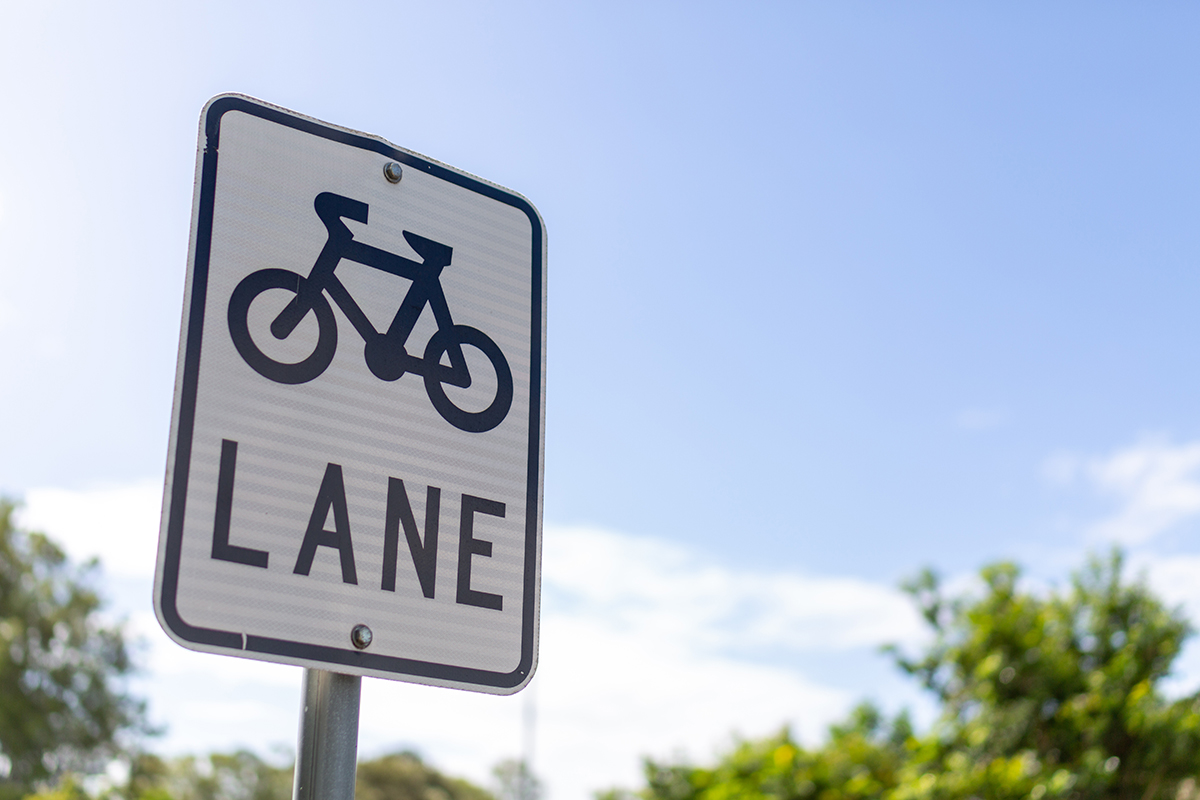
- If a marked bicycle lane is present, you must ride in this lane. A bicycle lane will be signposted or have a road marking of a picture of a bicycle and the word ‘lane’ beneath it, for example:
Paths:
- Cyclists can ride on any path, unless:
- there is a “no bicycles” sign or path marking, or
- there is a “pedestrians only” sign or path marking.
- Keep to the left of the path, unless overtaking.
- Only overtake where it is safe to do so (no oncoming pedestrians/riders).
- When riding across a pedestrian crossing, you must:
- cross from the connected path and not the road;
- give way to all pedestrians; and
- slow down to 10km/h or less.
Motorcyclists
Motorcycle rules and safety
Motorcycle riders and their passengers are among our most vulnerable road users for several reasons:
- Motorcycle riders have very little protection in the event of a crash.
- Motorcycle riders are more affected by variations in road conditions.
- It takes more skill, concentration and control to safely ride a motorcycle compared to a passenger car.
Motorcycle rules overview
Motorcyclists need to follow many of the same road rules as car or truck drivers, but there are some rules specific to motorcyclists to be aware of:
- Wear a helmet. The rider and any passengers must all wear helmets.
- Be properly seated. If the motorcycle is moving, you should sit astride the seat, facing forward, with both feet on the footrests and at least one hand on the handlebars.
- Pillion passengers (passengers seated behind the rider) must be at least eight years old.
- One pillion passenger at a time.
- Leave your pets at home. Unless you’re carrying out a farming activity and travelling less than 500 metres, never ride with an animal between the rider and the handlebars, or in any other position that interferes with your ability to control the motorcycle.
Lane filtering overview
Lane filtering is where a motorcycle rider travels at low speed between two lanes of stopped or slow-moving vehicles travelling in the same direction. It is illegal to lane filter in school zones, or in areas where the posted speed limit is 40km/h or less.
When lane filtering, remember:
- Keep a buffer of space between you and the other vehicles on the road.
- Travel at 30km/h or less.
- Never lane filter between trucks or heavy vehicles.
Safe riding overview
See and be seen
- Ride with your headlight on low beam during the day. This helps make you more visible.
- Wear high-vis, reflective, or fluorescent clothes. Choose a light-coloured helmet that can be easily seen.
- Avoid another vehicle’s blind spots – if you cannot see their side mirrors, they cannot see you.
- Remember to check your mirrors and your own blind spots before changing lanes or making turns. If you have convex mirrors, things look further back than they actually are, so always do a head check.
- Look out for indicators and brake lights – it will help you anticipate the actions of the drivers around you and react accordingly.
Wear a helmet and protective gear
Always wear a helmet and protective gear. The right gear can protect your body and head in a crash and reduce your risk of injury. Protective gear can also make you more comfortable during the ride and protect you from the weather.
Keep a safe distance
Keep a three second gap between you and the vehicle in front. If someone makes a mistake or you spot a hazard, space gives you time to react and somewhere to go. Always be prepared to slow down, stop, or reposition yourself in the lane.
In low visibility or poor weather, increase this gap to four seconds.
When you stop behind another vehicle, leave at least one car length between your front wheel and the back of the vehicle in front. This gives you room to move if you need to go around them or if they start to roll back.
Slow down if you don’t have a clear view
Always have a clear view of the road ahead. You should be able to see five seconds ahead to have enough space to respond to hazards. To tell if you can see far enough ahead, pick a fixed point in the oncoming lane and count to five. If you pass that point before you get to five, you are going too fast for the available vision and need to slow down.
Ride to the conditions
- Rain, fog, sunset, sunrise or nighttime can reduce visibility and make it harder to see the road ahead. Reduce your speed so that you need less space to stop.
- Give other vehicles plenty of space. In bad weather, give them more space than usual.
- High winds can cause gusts and crosswinds. Keep a firm grip on the handlebars and slow down. Wind buffeting can affect the handling of your motorcycle and reducing your speed can help you regain control.
- Heat haze can hide approaching vehicles – make sure the path is clear before overtaking.
- Remember that painted arrows and road markings can be extra slippery after rain.
- Riding in bad weather is tiring, so watch for signs of fatigue.
If you get tired, stop and rest
Signs that you might need a break include:
- lapses in concentration
- running wide on corners
- missing road signs
- daydreaming
- rough gear changes
- dry mouth or stiff joints
To help manage your energy levels, there are a few things you can do:
- Stay hydrated and drink plenty of water.
- Eat small amounts often. Avoid large meals or fatty foods before or during a ride.
- Stop every one-and-a-half hours or every 150 kilometres for a break.
Check your motorcycle regularly
It is a good idea to have your bike serviced regularly to make sure it is roadworthy, safe and reliable. To be ready for the road, your motorcycle must have:
- a red taillight, brake light, rear reflector
- a light to illuminate the rear numberplate
- rear vision mirrors
- working headlight and indicators
- a horn
- tyres with a tread of at least 1.5mm
- brakes in good condition
- footrests.
Senior Drivers
Road safety risk
There are many reasons the road safety risk increases for senior road users, whether you are driving or using the roads as a pedestrian.
Medication
- Check warning labels on medication and don’t drive if the medicine causes sleepiness, nausea, blurred or double vision, dizziness and shaking.
- Check with your doctor or pharmacist if you are not sure about the effects of your medication.
Vision
- Whether you are using the roads as a driver or as a pedestrian, vision naturally deteriorates as we age.
- Deterioration of eyesight and hearing makes it harder for seniors to judge distances and the speed of traffic.
- It is important to wear spectacles if they have been prescribed and to also have regular eye and hearing checks.
Flexibility
- Some seniors may experience reduced flexibility and slower reaction time.
- These factors can also affect driving ability and your safety as a pedestrian.
Regional Drivers
Choose the right vehicle
A conventional SUV, sedan or hatchback is suitable if you are travelling on sealed and well-maintained roads, such as the Perth metropolitan area and major towns and highways.
A four-wheel drive (4WD) vehicle is the best option if you plan to visit regional or remote areas.
Be aware of animals on the road
Australian wildlife roam roadsides around WA and sometimes stray onto the road.
Animals such as kangaroos, cattle, camels and emus are unpredictable, so drive slowly and don’t try to swerve around an animal.
Animals under the control of people, such as horse riders and carriage drivers, may also be on or near the road. For a guide on how the road rules apply to horse riders or carriage drivers.
Gravel and sand roads
Some roads outside urban areas and towns have gravel edges or consist of red dirt and small stones.
Gravel can act like ball-bearings under car tyres, while sand tracks often form pockets like snow drifts, so drive to the conditions.
Be aware that gravel and dirt roads also create dust clouds of dust that impede visibility, and loose stones can strike your windscreen.
Low visibility
Drivers can encounter bushfire smoke, fog and torrential rain while driving in WA, all of which reduce visibility.
In these conditions, slow down, switch on your headlights, use your windscreen wipers, allow extra braking distance and do not attempt to cross flooded roads.
Towing
If you are going to tow a caravan, trailer or boat, be sure you know the legal load limit for your vehicle and make sure your load is well secured.
Heavy or poorly secured loads can cause rollovers and accidents.
Driving on the left
If you are not used to driving on the left, tape a note on your dashboard to remind you to keep left and take extra care when approaching an intersection or making turns.
On multi-lane roads you may only drive in the right-hand lane if you are overtaking, the left lane is a special purpose lane (bus, cycle) or you’re avoiding an obstruction.
Overtaking
There are risks when overtaking other vehicles, so only overtake when it is safe to do so and you have a clear view of the road ahead. If you are not sure, wait.
You must not cross single continuous dividing lines or continuous dividing lines on your side of broken lines or double continuous dividing lines, to overtake another vehicle.
You must not exceed the speed limit to overtake.
WA is home to some of the largest trucks in the world known as ‘road trains’ (they can be up to 60m long), so be aware that it may take some time to overtake one.
Emergency services vehicles
Clearing the path for emergency service vehicles
If you see flashing lights and hear sirens, it’s time to take action.
When responding to an emergency, it’s vital that first responders are able to get to an incident quickly and safely.
Flashing lights on a stationary vehicle means you MUST slow down, move over (if possible) and pass at no more than 40km/h. In doing so, you should apply your brakes gradually and safely.
This applies to drivers in all lanes that travel in the same direction as the lane where the emergency or response vehicle is stopped. Vehicles travelling in oncoming traffic from the other direction only need to slow if the incident occurred in the middle of the road or in the medium strip.
If you see lights or hear sirens from an emergency vehicle on the road, just remember these four simple steps:
- Stay calm, check your surroundings. Remain calm and safely check your surroundings and pay attention to where the emergency services vehicle is coming from.
- Safely merge to the left. Give way to the emergency vehicle by merging as far to the left of the road as possible. And make room for other road users to move to the side too.
- Can’t move over? Slow down and indicate left until the emergency vehicle has passed.
- Don’t break the law. There’s no excuse for speeding or going through a red light.
Towing
There are specific road rules that apply to motorists towing caravans, camper trailers, horse floats, boats and more:
- The maximum legal speed limit for any vehicle towing a trailer or caravan is 100km/h.
- Vehicles towing a caravan or trailer must drive at least 60m behind heavy vehicles or other towing vehicles, unless overtaking. Drivers of road trains or B-doubles must maintain a following distance of at least 200m, unless overtaking.
- People are not permitted to ride in a trailer or caravan that is being towed.
- Failure to properly secure a load will attract a $150 infringement.
- If you are towing a load wider than your vehicle, you must have towing mirrors in place.
You must not drive a vehicle that is carrying a load:
- If the load makes the vehicle unstable or otherwise unsafe.
- If the load projects from the vehicle in a way that could injure a person, obstruct the path of other drivers or pedestrians, or damage a vehicle or anything else (including the road surface).
- Unless the load is restrained on the vehicle so that the load, or any portion of it is unlikely to fall or become dislodged from its restraints.
Be sure you know the legal load limit for your vehicle and make sure your load is well secured as incorrectly secured loads can cause rollovers.
Add 200kg to the weight shown on the vehicle licence paper to allow for bedding, travelling gear, stores, and equipment.
Be courteous in sharing the road with other users. Check your rear vision mirror regularly to see if traffic is building up behind you. If you are holding up traffic, pull over and stop when it is safe to do so. There are 1,648 Main Roads WA rest stops and amenities around WA to avoid fatigue.
If you wish to drive on unsealed roads in remote areas, ensure that your caravan or camper trailer is built to handle these tough conditions (check with the manufacturer). Make sure it has four-wheel-drive tyres with a high clearance and upgraded suspension that can withstand corrugations and rough road surfaces.